Aim
The previous vignette measured population coverage bias and showed that some spatial units are better covered by the digital trace data than others. The next natural question to ask is whether those differences in coverage are related to the characteristics of the local populations. The aim in this vignette is to address that question. To this end, we use a simple regression model as a means to illustrate the workflow for package users. The research papers (Cabrera and Rowe 2025; Cabrera et al. 2026) associated with the DEBIAS methodology for bias assessment use more flexible machine-learning methods.
Load data
Like in the rest of the debiasR documentation, we use UK data at the local authority district (LAD) level for illustration. We start by loading the required packages:
We then load the necessary datasets from debiasRdata: the coverage and the covariates datasets. The coverage dataset contains the benchmark Census population and the observed digital trace user count for each LAD. It stores the LAD identifier in a column called code. We rename it to area so that it uses the same identifier name as the covariate table and the rest of the debiasR workflow.
coverage <- debiasRdata::coverage_lad |>
  rename(area = code)

head(coverage)
date name area population user_count
1 2021 Hartlepool E06000001 92338 1207
2 2021 Middlesbrough E06000002 143926 1028
3 2021 Redcar and Cleveland E06000003 136531 1144
4 2021 Stockton-on-Tees E06000004 196595 1755
5 2021 Darlington E06000005 107799 1165
6 2021 Halton E06000006 128478 1744The covariate table contains selected area-level characteristics from the 2021 Census, including percentage of UK-born residents, percentage of residents aged 20-29, percentage of residents aged 70 or over, percentage of residents with Level 4 qualifications, percentage of households without central heating, percentage of residents in routine occupations and percentage of rural land.
covariates <- debiasRdata::lad_covariates

head(covariates)
area name year per_ukborn per_age_20.29 per_age_70plus
1 E06000001 Hartlepool 2021 96.03505 11.48510 14.06370
2 E06000002 Middlesbrough 2021 87.71191 14.23857 11.79217
3 E06000003 Redcar and Cleveland 2021 97.08560 10.28030 17.02885
4 E06000004 Stockton-on-Tees 2021 93.76027 10.99062 13.42404
5 E06000005 Darlington 2021 92.18360 10.95073 14.91823
6 E06000006 Halton 2021 95.23031 11.41587 13.00290
per_level4 per_hh_no_centralheat per_NS_SeC_L13_routine rural_pct
1 24.80518 0.8355729 15.71647 3.0949158
2 26.44134 1.2478842 15.06082 0.2195405
3 24.92656 0.9231318 14.94379 31.6923280
4 29.52218 0.8417207 14.10037 5.5527863
5 28.96138 0.9526146 15.20799 13.0556973
6 23.93120 1.4351844 16.35048 0.7223308Next, we use the measure_bias() function to calculate the active-user coverage rate and coverage bias.
bias_lad <- measure_bias(coverage)

bias_lad |>
  select(area, population, user_count, coverage_score, coverage_bias) |>
  head()
area population user_count coverage_score coverage_bias
1 E06000001 92338 1207 0.013071542 0.9869285
2 E06000002 143926 1028 0.007142559 0.9928574
3 E06000003 136531 1144 0.008379049 0.9916210
4 E06000004 196595 1755 0.008926982 0.9910730
5 E06000005 107799 1165 0.010807150 0.9891928
6 E06000006 128478 1744 0.013574308 0.9864257The previous vignette introduced the idea of a proportional baseline. If every LAD were covered at the same overall rate, the local coverage rate would be the same as the national average. Using the function validate_bias_residual_structure(), we can extract the area_level object and inspect which locations (LADs) depart from the simple assumption of the proportional baseline model. Positive values of residual_bias identify LADs with more coverage bias than expected under the proportional baseline. Negative values identify LADs with less coverage bias than expected.
bias_residuals <- validate_bias_residual_structure(
  coverage_df = coverage,
  coverage_area_col = "area",
  population_col = "population",
  user_count_col = "user_count"
)

residual_lad <- bias_residuals$area_level |>
  mutate(
    baseline_coverage_bias = 1 - global_coverage_score,
    residual_bias = coverage_bias - baseline_coverage_bias
  ) |>
  left_join(
    coverage |> select(area, name),
    by = "area"
  )

residual_lad |>
  select(area, name, coverage_score, coverage_bias, residual_bias) |>
  head()
area name coverage_score coverage_bias residual_bias
1 E06000001 Hartlepool 0.013071542 0.9869285 -0.0020957494
2 E06000002 Middlesbrough 0.007142559 0.9928574 0.0038332327
3 E06000003 Redcar and Cleveland 0.008379049 0.9916210 0.0025967426
4 E06000004 Stockton-on-Tees 0.008926982 0.9910730 0.0020488102
5 E06000005 Darlington 0.010807150 0.9891928 0.0001686417
6 E06000006 Halton 0.013574308 0.9864257 -0.0025985164Next, we can join these residuals to the area-level covariates via a left_join that uses the area identifier as the key to merge the two relevant datasets.
bias_covariates <- residual_lad |>
  left_join(
    covariates |>
      select(
        area,
        per_age_20.29,
        per_age_70plus,
        per_level4,
        per_hh_no_centralheat,
        per_NS_SeC_L13_routine,
        rural_pct
      ),
    by = "area"
  )

bias_covariates |>
  select(
    area,
    residual_bias,
    per_age_20.29,
    per_age_70plus,
    per_level4,
    rural_pct
  ) |>
  head()
area residual_bias per_age_20.29 per_age_70plus per_level4 rural_pct
1 E06000001 -0.0020957494 11.48510 14.06370 24.80518 3.0949158
2 E06000002 0.0038332327 14.23857 11.79217 26.44134 0.2195405
3 E06000003 0.0025967426 10.28030 17.02885 24.92656 31.6923280
4 E06000004 0.0020488102 10.99062 13.42404 29.52218 5.5527863
5 E06000005 0.0001686417 10.95073 14.91823 28.96138 13.0556973
6 E06000006 -0.0025985164 11.41587 13.00290 23.93120 0.7223308Explore one relationship at a time
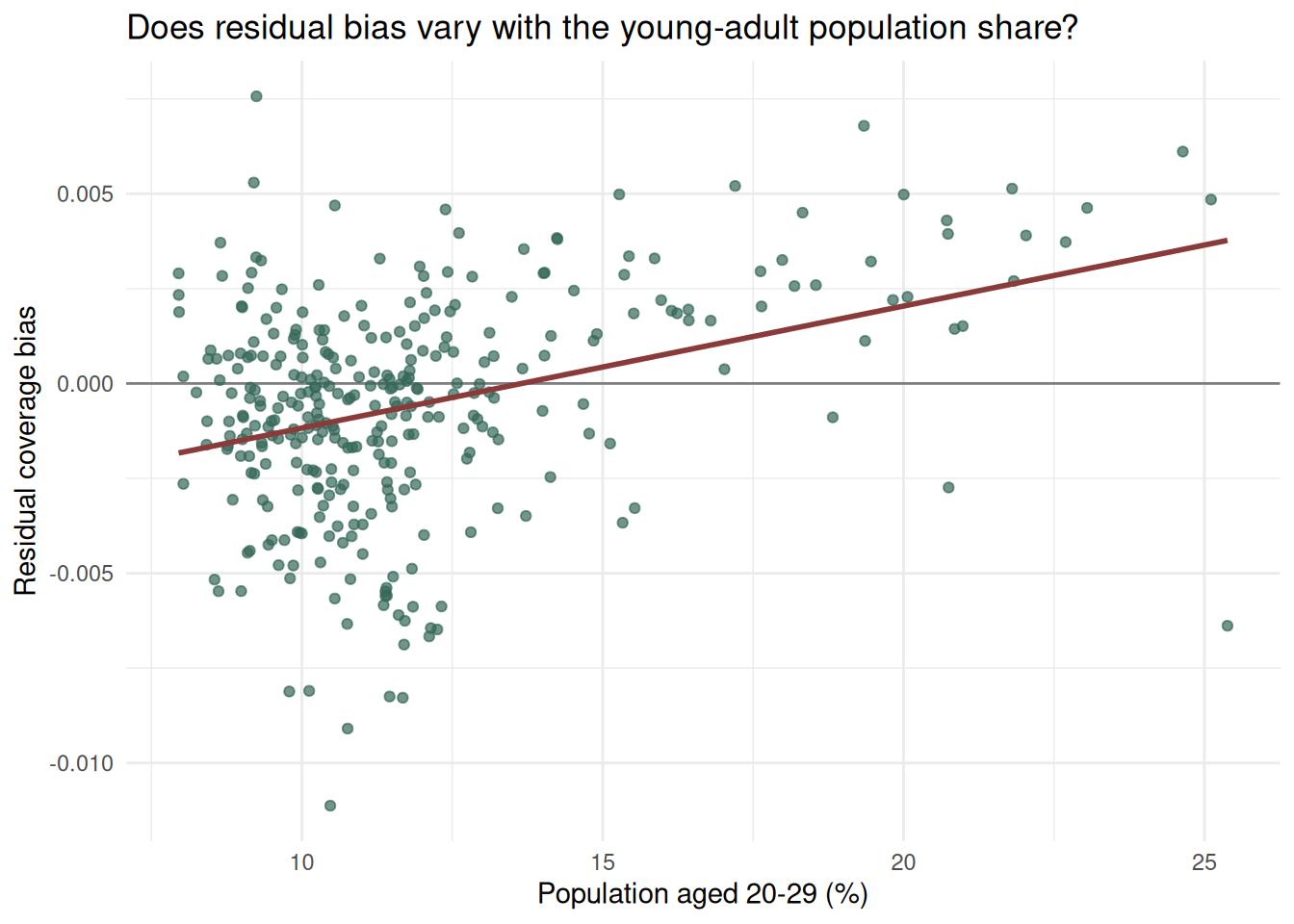
Before fitting a more complex multivariate model, it is useful to look at simple bivariate relationships. This inspection enables us to see whether residual bias tends to be higher or lower in areas with different local characteristics. For example, below we plot the residual coverage bias against the percentage of population aged between 20 and 29 (left panel) and the percentage of population with level 4 qualifications. While these plots do not prove causality, they help us identify whether coverage bias displays any meaningful patterns rather than being randomly distributed across places.
Fit a simple explanatory model
We now fit a multivariate linear regression. The outcome variable in the regression is residual_bias, which compares the coverage bias of an LAD has compared with the proportional baseline. The predictors in this regression are the variables in the covariates dataset: - per_age_20.29: share of the population aged 20-29 - per_age_70plus: share of the population aged 70 or over - per_level4: share of the population with Level 4 qualifications - per_hh_no_centralheat: share of households without central heating - per_NS_SeC_L13_routine: share of the population in routine occupations - rural_pct: rural population share
Below we fit the model and extract a table of fitted regression coefficients. The sign of each coefficient (estimate) gives the direction of the association, holding the other variables in the model constant. A positive coefficient means that higher values of the covariate are associated with more residual coverage bias (less representation than average in the mobile phone dataset). A negative coefficient means that higher values are associated with less residual coverage bias.
bias_model <- lm(
  residual_bias ~
    per_age_20.29 +
    per_age_70plus +
    per_level4 +
    per_hh_no_centralheat +
    per_NS_SeC_L13_routine +
    rural_pct,
  data = bias_covariates
)

coefficient_table <- as.data.frame(coef(summary(bias_model)))
coefficient_table$term <- rownames(coefficient_table)
rownames(coefficient_table) <- NULL
names(coefficient_table) <- c("estimate", "std_error", "statistic", "p_value", "term")

coefficient_table |>
  select(term, estimate, std_error, statistic, p_value)
term estimate std_error statistic p_value
1 (Intercept) -2.133358e-02 2.558308e-03 -8.3389386 2.173616e-15
2 per_age_20.29 2.300286e-04 6.736613e-05 3.4146024 7.199558e-04
3 per_age_70plus 2.154692e-04 6.687211e-05 3.2221083 1.401820e-03
4 per_level4 2.347167e-04 3.470325e-05 6.7635367 6.297559e-11
5 per_hh_no_centralheat 6.680707e-04 1.332254e-04 5.0145895 8.769749e-07
6 per_NS_SeC_L13_routine 5.217525e-04 7.486137e-05 6.9695826 1.786132e-11
7 rural_pct -7.687229e-06 8.213161e-06 -0.9359648 3.499884e-01Compare observed and fitted residuals
The fitted values from the model summarise the part of residual bias that can be described by the selected covariates. But how well is the observed residual bias described by the selected covariates? To answer this question we plot observed vs fitted residual bias. The largest unexplained residuals are areas where the simple model does not capture the local pattern well. These areas may be useful to inspect before choosing a bias adjustment strategy.
bias_covariates <- bias_covariates |>
  mutate(
    fitted_residual_bias = fitted(bias_model),
    unexplained_residual = residual_bias - fitted_residual_bias
  )

ggplot(bias_covariates, aes(x = fitted_residual_bias, y = residual_bias)) +
  geom_hline(yintercept = 0, colour = "grey80") +
  geom_vline(xintercept = 0, colour = "grey80") +
  geom_point(alpha = 0.7, colour = "#356859") +
  geom_smooth(method = "lm", se = FALSE, colour = "#8B3A3A") +
  labs(
    x = "Fitted residual bias",
    y = "Observed residual bias"
  ) +
  theme_minimal()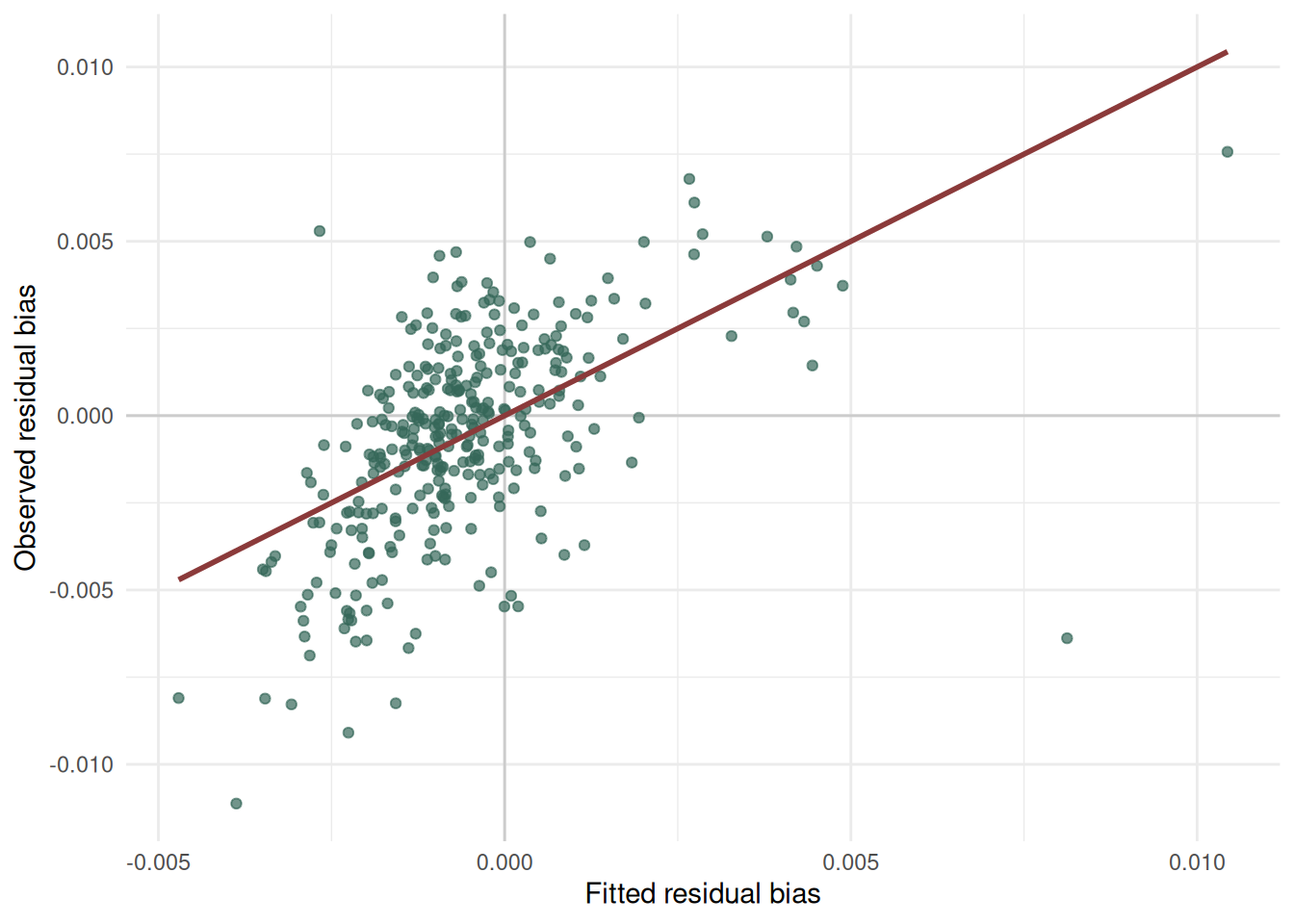
Interpretation
This vignette uses a simple regression to “explain” bias. If residual bias shows a non-trivial relationship with area-level characteristics, then the variation in bias across geographies is not simply random noise. Instead, this is a sign that some types of places are more or less visible in the digital trace data than expected under a constant-coverage baseline. Therefore, bias adjustment methods need to allow bias to vary across places too.
The regression used here is deliberately simple and descriptive. The associated research papers (Cabrera and Rowe 2025; Cabrera et al. 2026) use more flexible explainable machine-learning methods to capture nonlinear and interacting relationships between bias and area-level covariates. The purpose of this vignette is to introduce the same logic in a way that is easy to inspect, reproduce and adapt.